.png)


AI Could Help Win a Nobel Prize Within a Year, Says Anthropic Co-Founder

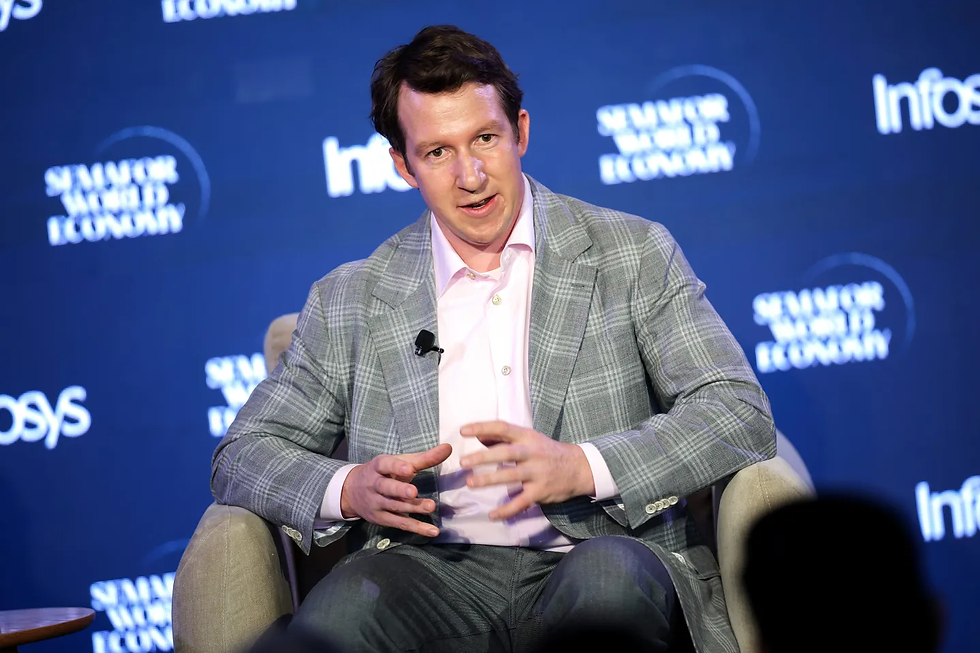
Artificial intelligence is advancing at a pace that even many experts find difficult to fully comprehend, and few recent predictions have captured that sense of acceleration more dramatically than those made by Anthropic co-founder Jack Clark during a lecture at Oxford University. Clark argued that within the next 12 months, an AI system working alongside humans could contribute to a Nobel Prize-winning scientific discovery, marking what could become one of the most significant milestones in the history of technology. His remarks arrive during a period of rapid breakthroughs in AI research, including OpenAI’s announcement that one of its internal models autonomously disproved Erdős’s unit-distance conjecture, a development that mathematician and Fields Medal winner Tim Gowers reportedly described as a “milestone in AI mathematics.”
Clark described today’s AI landscape as creating a “vertiginous sense of progress,” suggesting that the technology is evolving faster than governments, institutions, and the public are prepared to handle. According to his forecasts, AI-operated companies could begin generating millions of dollars in revenue within the next 18 months, while by the end of 2028, AI systems may become capable of designing their own successors. He also predicted that bipedal robots could soon assist skilled tradespeople, potentially transforming industries that have traditionally depended entirely on human labor.
Although Clark emphasized the extraordinary economic and scientific opportunities AI may create, he also issued serious warnings about the risks associated with increasingly powerful systems. He stated that there remain plausible scenarios in which AI has “a non-zero chance of killing everyone on the planet,” stressing that society should not dismiss existential concerns simply because the technology is producing useful or profitable results. Clark compared humanity’s current approach to AI with the world’s failure to adequately prepare for global pandemics such as COVID-19. In his view, if society allows “synthetic intelligence” to expand unchecked, humanity could eventually be forced into a reactive position instead of proactively shaping how the technology develops.
Clark acknowledged that slowing AI development might give humanity more time to prepare for the social and ethical consequences of advanced systems, but he expressed skepticism that such a slowdown would actually occur. He pointed to intense competition between technology companies and rival nations, arguing that commercial incentives and geopolitical rivalries are driving AI progress at a relentless pace. Anthropic itself, founded by former OpenAI researchers who left over disagreements concerning AI safety, has become one of the most influential companies in the field. The company has also faced criticism from some political figures and AI acceleration advocates, including voices associated with Donald Trump’s White House, who accuse Anthropic of exaggerating AI risks in order to support tighter regulations that may benefit its competitive position. Anthropic has denied those accusations.

The lecture also highlighted broader concerns about how AI could affect human thinking and decision-making. Professor Edward Harcourt, director of Oxford’s Institute for Ethics in AI and co-host of the event, warned that overreliance on AI systems could lead to “cognitive atrophy,” weakening human judgment as people increasingly outsource intellectual tasks to machines. Harcourt advocated for so-called “Socratic” AI systems designed to encourage users to think critically instead of simply relying on automated answers.
Despite the uncertainty surrounding AI’s long-term trajectory, Clark maintained that profound societal changes are becoming unavoidable. He suggested that the world could eventually see a machine economy partially detached from the human economy, scientific
breakthroughs achieved with minimal human involvement, and entirely new forms of scientific instruments and technologies that people have not yet imagined. While Clark admitted that some of these predictions may sound “crazy,” his remarks reflect a growing belief among leading AI researchers that the next few years could fundamentally reshape science, business, and daily life.
Works Cited
“AI May Make Nobel Prize-Winning Discovery by 2027: Anthropic Co-Founder.” NewsBytes, 21 May 2026, https://www.newsbytesapp.com/news/science/ai-may-make-nobel-prize-winning-discovery-by-2027-anthropic-co-founder/story.
Booth, Robert. “AI Will Help Make a Nobel Prize-Winning Discovery Within a Year, Says Anthropic Co-Founder.” The Guardian, 21 May 2026, https://www.theguardian.com/technology/2026/may/21/ai-nobel-prize-winning-discovery-robots-jack-clark-anthropic.
“GettyImages-2271201349.” Fortune, Apr. 2026, https://fortune.com/img-assets/wp-content/uploads/2026/04/GettyImages-2271201349.jpg?format=webp&w=1440&q=100.
“Jack Clark Predicts AI Will Help Win a Nobel Within a Year.” ResultSense, 21 May 2026, https://www.resultsense.com/news/2026-05-21-jack-clark-anthropic-ai-nobel-prize-prediction/.
“Jack Clark.” The New York Times, 24 Feb. 2026, https://static01.nyt.com/images/2026/02/24/opinion/24eks-clark-image/24eks-clark-image-articleLarge.jpg?quality=75&auto=webp&disable=upscale.


Comments