.png)


AI Boosts EEG Analysis: Could This Transform Dementia Detection?

Researchers at Örebro University have developed two advanced AI models that could significantly improve how dementia is detected, using nothing more than the brain’s natural electrical activity captured through EEG signals.
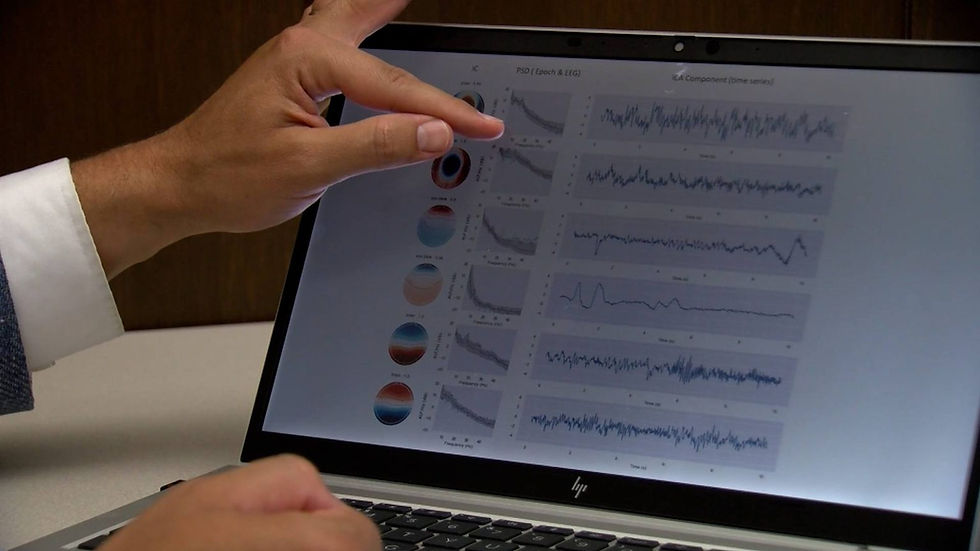
These models were designed to distinguish between healthy individuals and those with dementia, including Alzheimer’s disease and frontotemporal dementia, offering new hope for earlier and more accessible diagnosis. By combining temporal convolutional networks with long short-term memory networks, the team created a system capable of interpreting complex EEG patterns with over 80 percent accuracy when comparing multiple diagnostic groups. Importantly, the researchers also incorporated explainable AI techniques that reveal which parts of the EEG signals influence the diagnosis, allowing clinicians to better understand how the model reaches its conclusions (Yahoo News).
A second study by the same team introduced a much smaller, privacy-preserving AI model that measures under one megabyte, small enough to run on lightweight and portable devices (Medical Device Network). Despite its compact size, the model delivers exceptional performance, achieving more than 97 percent accuracy in dementia classification. This breakthrough was made possible through federated learning, a method that allows healthcare providers to jointly train the AI system without sharing raw patient data. This means hospitals, clinics, and research centers can collaborate securely, keeping sensitive medical information protected while still contributing to a more accurate diagnostic tool.

Central to both models is their ability to interpret EEG signals by breaking them down into alpha, beta, and gamma wave frequency bands. By doing so, the AI can detect long-term changes and subtle abnormalities that often point to emerging cognitive decline. These detailed analyses allow the systems to differentiate not just between healthy and unhealthy brain activity but also between different types of dementia, something that has traditionally required more invasive or expensive diagnostic approaches. The addition of explainable AI ensures that the technology does not operate as a “black box” but instead offers clear visibility into the reasoning behind its outputs, a crucial factor for clinical adoption (News-Medical).
Researchers emphasized that early diagnosis is essential for slowing disease progression and improving quality of life. According to Örebro University informatics expert Muhammad Hanif, current machine-learning models often struggle with transparency and privacy, which are major barriers in clinical settings. The newly developed models aim directly at these challenges, offering both interpretability and strict data protection. As dementia rates continue to rise globally, such innovations could reduce strain on specialists and streamline the diagnostic journey for patients and families (Yahoo News).

Örebro University informatics researcher Muhammad Hanif
The accessibility of EEG technology makes this advancement especially promising. EEG tests are already inexpensive, non-invasive, and widely available in primary care settings. Pairing them with compact AI models could enable quicker screening, more frequent monitoring, and eventually even at-home assessments through wearable or portable devices. The research team is already planning future expansions, including larger and more diverse datasets and the inclusion of other dementia types such as vascular dementia and Lewy body dementia (News-Medical).
These studies were conducted in collaboration with international partners spanning the UK, Australia, Pakistan, and Saudi Arabia, reflecting a growing global effort to harness AI for neurological health. If fully implemented, the researchers believe their models could transform the pathway to diagnosis, making it faster, more accurate, and more secure for millions of people worldwide.
This article was written by the Covertly.AI team. Covertly.AI is a secure, anonymous AI chat that protects your privacy. Connect to advanced AI models without tracking, logging, or exposure of your data. Whether you’re an individual who values privacy or a business seeking enterprise-grade data protection, Covertly.AI helps you stay secure and anonymous when using AI. With Covertly.AI, you get seamless access to all popular large language models - without compromising your identity or data privacy.
Try Covertly.AI today for free at www.covertly.ai, or contact us to learn more about custom privacy and security solutions for your business.
Works Cited
“New AI Models Detect Dementia with High Accuracy Using EEG Signals.” News-Medical, 27 Nov. 2025, www.news-medical.net/news/20251127/New-AI-models-detect-dementia-with-high-accuracy-using-EEG-signals.aspx.
“Örebro University Researchers Develop New AI Models for Dementia.” Yahoo News, www.yahoo.com/news/articles/rebro-university-researchers-develop-ai-105937111.html.
“Örebro University Researchers Develop New AI Models for Dementia.” Medical Device Network, www.medicaldevice-network.com/news/ai-models-for-dementia/.
Getty Images. “Doctor Reviewing Scan.” Getty Images, www.gettyimages.in/videos/doctor-reviewing-scan.
Mayo Clinic News Network. “AI Boosts the Power of EEGs, Enabling Neurologists to Quickly, Precisely Pinpoint Signs of Dementia.” Mayo Clinic News Network, newsnetwork.mayoclinic.org/discussion/ai-boosts-the-power-of-eegs-enabling-neurologists-to-quickly-precisely-pinpoint-signs-of-dementia/.


Comments